he Paris Masters doesn't waste time. From the first ball struck in Bercy。the ATP's final Masters 1000 event of the season demands immediate adaptation—no warm-up week, no gradual ramp-up. The court is quick, the bounce low, and the margins thinner than at any other hard-court stop. I've watched players arrive in Paris fresh off a long-haul flight and get dismantled in 70 minutes by a qualifier who simply reads the surface better. That's the tournament's defining tension: it rewards specialists while punishing anyone still recalibrating.Novak Djokovic's record seven titles here tell only part of the story. His 2019 final against Denis Shapovalov was a masterclass in early-strike tennis—Djokovic won 78% of first-serve points and never faced a break point. But the more revealing number is his return position: standing nearly two meters inside the baseline on second serves。
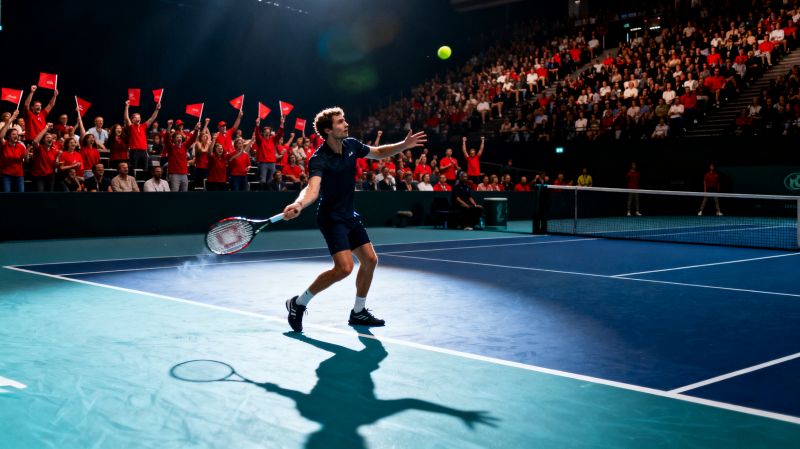
a gamble that only works on a court this fast. Few players replicate it. Daniil Medvedev, who won in 2020, took a different route—deep return position, extended rallies, and a willingness to grind out 6-4, 6-4 sets that looked routine but were anything but. The Paris Masters doesn't have one blueprint. It has several, and they don't overlap.The event's late-season slot creates a peculiar dynamic. Players are physically frayed, and the Paris Masters often doubles as a last-chance qualifier for the ATP Finals. In 2022, Holger Rune arrived ranked 18th and left with the title—a run that included saving three match points against Stan Wawrinka in the second round. Rune's week was chaotic, emotional。and utterly compelling. He argued with his box, changed tactics mid-match, and somehow pieced together five wins in six days. That kind of narrative doesn't happen at a mid-season Masters. The fatigue is real, and it produces unpredictable tennis.Bercy's atmosphere deserves its own paragraph. The arena is compact by Masters standards—just over 15,000 for center court—and the crowd sits close enough that you can hear players muttering to themselves between points. It's not Wimbledon polite. It's Parisian: impatient, knowledgeable, occasionally brutal. When a French player steps on court, the noise spikes. When a seeded player struggles, the murmurs start. I've seen more than one top-10 player glance nervously at the stands after a double fault. The Paris Masters crowd doesn't just watch;it participates。
whether the players want them to or not.Looking ahead, the tournament's future feels secure but its identity is shifting. The ATP has discussed surface tweaks and scheduling changes, and the Paris Masters may eventually move from Bercy to a new arena. That would be a mistake if it dilutes the court speed. The event works because it's uncomfortable—a quick。low-bouncing, late-season test that exposes technical flaws and rewards decisive shot-making. Strip that away, and you get another generic hard-court Masters. Keep it, and the Paris Masters remains what it has always been: the ATP's fastest fortnight, and one of its most honest.